


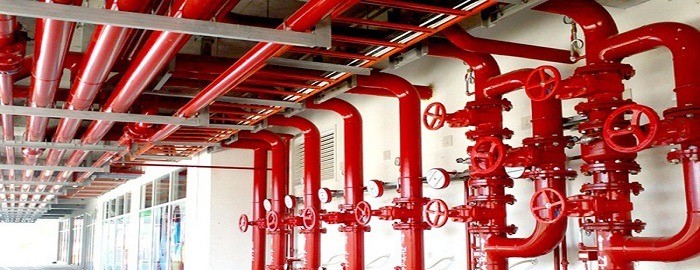
Fire piping
Fire piping is one of the main and most important parts of building piping.
Because in case of fire, this system has the ability to deal with it.
Although such an incident may not occur until the end of the useful life of a building, but for the sake of precaution, great care should be taken in carrying out the firefighting piping and it must be done in the best way.
Start of firefighting piping
The engine room is the place where the building’s firefighting piping starts.
In addition to all the tools inside the engine room, special booster pumps have been used to pump firefighting water, and the main riser of the firefighting piping is also removed from these booster pumps.
The riser taken out of the engine room goes up vertically and is stretched to the last floor of the building, and a branch is taken from the riser in each floor and each section, and the continuation of the fire fighting piping is done on the roof of the floors.
Types of fire water piping
There are different types of firefighting piping depending on the method used in firefighting.
Fire extinguishing is generally done in three ways.
Each of these items are intended for specific conditions and the items required are specific to their method.
But the goal of all three systems is the same and finally extinguishing the fire.
Firefighting piping in a more method (Firefighting riser)
In this system, as its name suggests, water always flows in pipes. This system is fed from the water source of the building and is connected to the city water.
For this reason, there is always water in the pipes and it flows by opening the inlet valve to the fire extinguisher box and the pipe head nozzle.
The water flow in this system starts from the lowest floor of the building (motor home) or the top floor of the building (rooftop) and enters the fire box.
Usually, the lower outlet of the fire box is used for the cooler system.
In general, to implement this water supply system, a butterfly valve, flow switch, water pressure gauge, three-way valve, sprinkler and cap are needed.
dry firefighting piping (firefighting dry riser)
This type of firefighting piping has dry pipes and there is no water in it.
The source of water needed in the piping of these systems or the fire extinguisher is not provided from the water sources of the building.
It starts from the entrance door of the building and has branches to connect the hose and increase and decrease the water in different floors of the building.
It is used during firefighting operations and makes firefighting operations simpler and more effective.
During a fire, by connecting the hoses of the fire engine to the inlet valve of the door, water is supplied to the system and water enters the different floors of the building through branches.
On both sides of the fire box, there are 4 holes at the top and bottom of the box, usually the top hole is related to dry fire piping.
In this method, there is no need to use a shut-off butterfly valve, and instead of using a flow switch, you should use a pressure switch.
Fire fighting piping by combined method (dry and wet)
As can be guessed from the name of this water supply system, this water supply method is a combination of wet and dry piping systems and can use both fire systems at the same time.
The advantage of using this example of firefighting piping is that you can use a water supply system to extinguish small fires and a dry water supply system that has a higher pressure and flow rate for large fires.
In large buildings where this water supply system is used, to compensate for the pressure drop that may occur due to the height, an automatic pump system should be considered for the water supply system of the fire fighting boxes.