


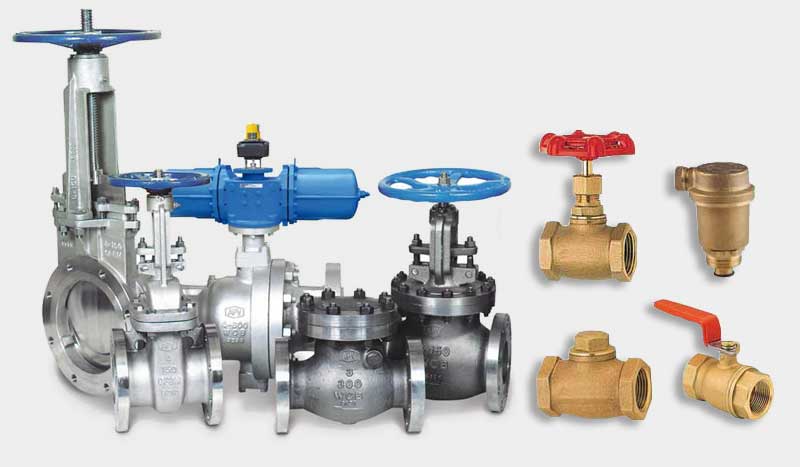
Types of faucets and their use
There are different types of faucets in terms of gender, appearance, brand and type of use, and they play a special role in building facilities and also as functional accessories in the decoration of houses and buildings.
Faucets are metal tools that are used to adjust or cut off and connect the flow of hot and cold water, the important use of sanitary faucets in homes is defined for the kitchen, toilet and bathroom.
It is very important to choose various models of sanitary faucets according to the needs and style of design and architecture of different spaces, and accuracy in their quality and durability is very necessary.
Industrial valves are another type of valves that are essential tools in the industry.
This product is a mechanical device that controls the pressure and fluid flow in a process in pipelines and piping networks and industrial environments and has different types for different applications.
All types of faucets
There are types of faucets in the form of modern construction and sanitary faucets and industrial faucets, although the main function of faucets is to distribute and transfer water.
According to different parts of home and workplace, such as bathroom, toilet or kitchen, these items are offered with special features.
The main components of industrial valves include the body, cap and cap, trim, operator and packing or waterproof ropes.
This product also has many models, each of which is used for different applications.
Ball valves, safety valves, ball valves, sliding valves, one-way valves, control valves, needle valves, breathing valves, cone valves and diaphragm valves are types of industrial valves.
Industrial Valves
Industrial valves are divided into two categories, cast iron valves and brass valves, in terms of body material.
Industrial valves play an important role in industries and have applications such as connecting and disconnecting and controlling the flow of ventilation systems and fluid transmission systems.
Industrial valves are used to optimize the performance conditions of transmission lines and can be installed in upstream, intermediate and downstream sections.
Oil and gas industries are considered a subset of transmission lines and different valves are used in this industry according to the pressure, temperature and performance conditions.
The type of fluid is an important factor in the selection of industrial valves, including its body material, disc material, and operator type.
Industrial valves include sliding valves to shut off and connect the water flow, butterfly valves to control the fluid flow rate, one-way valves to control the flow direction, pressure relief valves to control the flow pressure, and strainers to clean the flow path.
The type of connection of cast iron valves is in the form of flanges and each of the cast iron valves needs two flanges, the type of connection of brass valves is in the form of ribs.
Industrial valve operator
The operator of industrial valves is manual or non-manual based on the application.
Manual operators are in the form of a gearbox or a lever that opens or closes the valve in a clockwise or counterclockwise direction.
The operator of these valves is a device that creates a rotary or linear movement and does this after receiving a message from the control systems.
In some applications, manual control of the valves is not possible and an actuator is installed on them, large size valves that are under high hydrostatic pressure.
Valves that are controlled from a remote location, when the time of opening and closing and controlling the valves is too much.
Types of industrial valve operators
There are different types of industrial valve actuators, such as electric actuators that work by electricity and open and close or adjust valves.
A pneumatic actuator that provides the necessary torque to adjust different valve modes with the help of wind and compressed air.
A hydraulic actuator that creates the necessary force to adjust valve positions by means of crude oil-based oil force.
Another type of actuator for these valves is the solenoid actuator, which is a type of electric actuator.
Application of industrial valves
All industrial valves have the same mechanism and differ from each other only in terms of construction.
The use of industrial valves such as gate valves is to create a connection between two fluid flows or complete disconnection, that is, it is either completely closed or open, gate valves are not suitable for half-open mode because they are sensitive to wear.
Opening and closing gate valves usually requires a lot of time and is not used in cases where the valve needs to be opened and closed quickly.
The application of these valves, including the control valve, which used to be based on basic parameters such as range, flow, pressure drop, etc., but now it is based on the emphasis on costs.
Industrial control valves should not only be suitable in terms of initial costs and maintenance costs, but also should have good control properties.
The ball valve has a completely spherical appearance in such a way that the liquid changes direction by 180 degrees from the point of entering the valve to the point of exit, and the internal structure of industrial ball valves causes this change.
Ball valves do not need to be fully open and this is an important advantage, because in this case they do not wear out.
Sliding valves are mostly used in places where they want to completely open and close the fluid flow, one of the properties of industrial sliding valves is the low pressure drop along it, and it is used in long pipes.