


Fire-fighting equipment
Firefighting equipment refers to the equipment that firefighters use in firefighting and rescue operations and perform rescue and firefighting operations.
Due to the increase in the population and the buildings that contain incendiary and flammable materials, there is a need for firefighting equipment in every building.
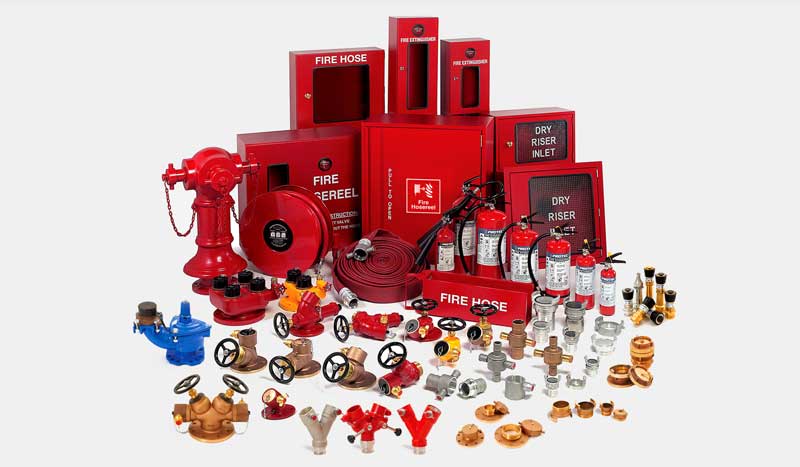
Firefighting equipment includes firefighting boxes, sprinklers, firefighting hoses, firefighting reels, hoseracks, fire extinguishers, firefighting fittings, coupling wrenches, and firefighting valves.
All types of fire fighting equipment
fire box
The fire box is one of the most used firefighting equipment and is a good place to store firefighting tools and equipment.
The fire box is produced in different sizes, designs and materials with different applications and its quality and strength are very remarkable.
All firefighting tools should always be of the best quality and ready for use in critical situations.
Fire fighting boxes that are used in more difficult conditions such as open areas for fire extinguishing, should be more equipped and made with special arrangements.
For example, it is necessary to use a special color coating or steel sheet material in the construction of a fire box for environments with a high risk of corrosion.
Fiberglass fire box
Coastal areas in the south and north of our country are areas with corrosive and aggressive climates. Very humid and hot weather, strong winds, wetting and drying cycles with dissolved water can affect the quality of firefighting equipment.
High concentration of chloride ions, high temperature difference between day and night, and contact with petroleum derivatives such as crude oil, diesel, and gasoline are the most important factors of corrosion exacerbation and are part of the basic characteristics of aggressive areas.
In these areas, the metal fire box is not used, and the fiberglass fire box is a suitable option.
Fire sprinkler
Fire sprinkler is one of the most effective, cheapest and safest fire extinguishing equipment, and there are two types of quick reaction sprinkler and standard reaction sprinkler.
Fire sprinkler is an automatic tool for automatic fire extinguishing in the early stages of fire.
The difference between these two fire extinguishing sprinklers is that the quick reaction sprinkler is activated earlier than the standard reaction sprinkler in times of danger and under the same conditions.
NFPA international standard requirements emphasize the use of quick response sprinklers in residential, commercial and office environments and places of gathering and living.
In terms of shape and type of spraying, fire extinguishing sprinklers are divided into three categories: top, bottom and wall.
Balazen sprinkler is usually used in cases where there are obstructions in front of proper distribution of flow.
The female bottom sprinkler is used in all situations and the flow spreading member is installed downward.
The wall sprinkler is installed on the side walls of the building, especially in the corridors and staircases of the buildings.
In low-risk environments such as residential, commercial and office buildings, quick response sprinklers or residential sprinklers should be used.
Each sprinkler has a heat-sensitive component, which can be a glass bubble or a melting metal.
The working mechanism of the glass bubble is that the liquid inside the bubble expands with increasing temperature.
When the fire starts and the temperature rises, the glass bubble breaks at a certain temperature, and in this way the sprinkler is activated and sprays water on the fire.
Fire hose
The fire hose is used to transfer the required water from a water source to the fire place. Due to the conditions of use and high pressure and flow rate, the hose must have high quality and efficiency.
There are three types of fire hoses;
Semi-hard PVC hose used to make fire hose rail.
Flat or tarpaulin fire hose, which is special for fire fighting applications and is used in reels and hozers with folding (tarpaulin) hose.
These hoses have an inner layer of rubber and an outer layer of perlon thread.
Anti-acid fire hose, which is very resistant, is used for fire extinguishing in a wide area.
Fire reel
The fire extinguisher is a convenient and practical tool for extinguishing fire in the early stages of a fire, and it is the right place for fire hoses.
Fire extinguishers are divided into two groups; Hoserail reels with semi-rigid hose and reels with flat or collapsible hose.
Hoserail reel with semi-hard hose has an internal water supply system and helps to provide water flow from the hoserail core and from the water supply system without any problems in opening and closing the hose.
Hoserails are usually produced with 3/4 and 1 inch diameter hoses, and due to the low flow rate and pressure of this reel, ordinary people and non-firefighters can use them.
The other type of reel is without a water supply system and is used to maintain fire fighting hoses.
Flat or tarpaulin fire hoses in this reel are usually produced with a diameter of 1.5 inches and more.
These reels are for the use of firefighters and professional operators due to the high pressure and flow rate of the water flow inside the flat fire hose.
Collapsible or tarpaulin hose hose
Hoserack is another fire fighting equipment that is used to maintain flat fire hoses.
This tool, like reels with collapsible hoses, is for the use of firefighters and professional operators.
The structure of Hozrak is such that the fire hose is placed in it hanging; Therefore, the flat fire hose dries faster and its outer layer is prevented from rotting.
Fire extinguisher
Fire extinguisher or capsule is the most famous fire fighting and fire extinguishing tool and it has different types.
The most widely used fire extinguisher is powder extinguisher and CO2 gas extinguisher.
Each extinguisher is used to extinguish a certain class of fire. Some extinguishers are multi-purpose and are used to extinguish two or three fire classes.
Having a fire extinguisher at home or at work is necessary. When a fire starts, it can be easily extinguished by releasing the valve latch and extinguishing hose and by targeting the fire in the first moments.
Choosing the type of fire extinguisher depends on many things, for example, a powder extinguisher cannot be used to extinguish a fire in an electrical panel. Because the extinguishing powder causes damage to the equipment and boards after extinguishing the fire.
One of the widely used fire extinguishers is the ABC multi-purpose extinguisher. This extinguisher properly extinguishes all three fire classes A, B and C and has high quality and extinguishing power.
Fire nozzles
Firefighting nozzles are key and effective equipment in firefighting operations, some nozzles are specially designed for use in fire hoserails and for connecting to the end of a semi-hard hose.
These nozzles are connected to semi-rigid hoses with a conversion sequence.
Another type of fire nozzles that pass a larger diameter and flow of water are for use by firefighters and professional operators and are connected to flat fire hoses with a Storz adapter.
Firefighting nozzles have jet spray and cone spray spray, jet spray is used for times when there is no access to the center of the fire or when the volume of fire is large.
Spraying is used for situations such as reducing the temperature of the fire environment and opening a way for people involved in the fire to leave by creating a water shield.
Fire fittings
Firefighting water connections are a requirement of every firefighting and firefighting team, and quick firefighting operations can only be done well by having quality, leak-free and quick-connecting connections.
Fire fittings are usually classified into two groups. English connections or German connections
BS fittings are manufactured under the British Standards Institution and are only designed for high pressure use, but German fittings are designed and manufactured based on the German DIN standard.
The connection mechanism is slightly different in these two groups. In English connections, the brass tab is responsible for connecting and maintaining the two connection components.
English coupling consists of two male and female components, but in German couplings, both components are similar and have tabs to pair with each other.
Coupling wrench
Coupling wrench is a versatile and widely used wrench in fire extinguishing and firefighting operations, which can be used to open and close connections, open barrel doors, and open fire hydrants in public roads.
Firemen’s uniforms are heavy, and using a lightweight multi-purpose wrench instead of carrying multiple wrenches with different uses can be very useful in firefighting operations.
Fire hydrants
Fire hydrants control the flow of water or are used to shut off the flow of water.
Types of fire hydrants
Fire hydrant
Fire hydrants are used at the beginning of the dry fire piping system, and there are two types of normal hydrants and pressure regulating hydrants.
The type of pressure regulation by having a mechanism to control the valve closing value, controls the water pressure in a certain range after the valve.
Standing fire hydrant
The standing valve is used in urban passages and for fire extinguishing operations with high pressure and flow rate, and it exists in two forms, surface and buried.
pressure relief valve
The pressure relief valve is used to control and stabilize the pressure at the beginning of the firefighting piping system, such as fire hoserail, hoserack and flat hose reels.
The difference between the pressure relief valve and the pressure regulating valve is that the pressure relief valve is for controlling and stabilizing the pressure, but the pressure relief valve has the ability to cut off and connect the flow.