


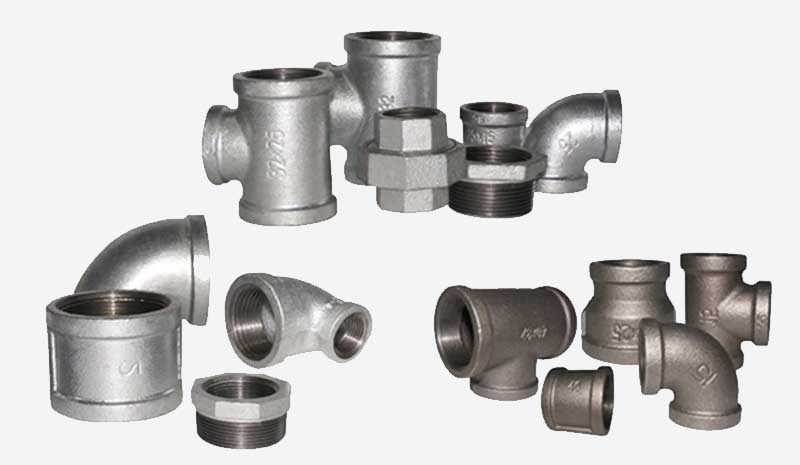
Metal fittings
Metal fittings are used to make connections between metal pipes and other piping items, including welded flanges, cast iron valves, brass valves, rubber shock absorbers, accordion shock absorbers, etc.
Metal joints are divided into several general categories according to the type of arrangement of its edges for connection and the alloy made.
All kinds of metal fittings
Manisman fittings: This type of metal fittings are welded and used together with Manisman and seamed pipes.
Their alloy is according to ASTM A234 WPB standard and its dimensional standard is according to ASME B16.9, which does not use any kind of welding seam in their manufacturing process.
Manisman fittings are suitable for high temperature and pressure systems and in different thicknesses, including Manisman fittings class 40, SGP and STD.
Black seamed joints: This type of metal joints is used as welding, and its difference with Manisman joints is in their manufacturing process.
These joints are made using the mold method and with welding seams in their bodies, which have a lower pressure and temperature tolerance than Manisman joints.
The price of seamed fittings is lower than that of Manisman fittings.
Galvanized rib joints: this type of joint is in the form of a thread and its connection is with galvanized pipes, the surface of these joints is galvanized and it is suitable for areas with high humidity and the possibility of rust and corrosion.
The galvanized fittings are with Brazilian hub brands, McCann and George Fisher.
High pressure joints: This type of metal joints have two types of gear and silent weld, which gear type can withstand much higher pressure and temperature than galvanized gear joints.
The alloy of these metal connections is according to ASTM A105 standard and their dimensional standard is according to ASME B16.11.
Metal pipe fittings
Metal pipe and plumbing connections are actually connecting pipes together or changing the direction, branching and converting the pipe from big to small and vice versa.
Pipe fittings which are made of iron, cast iron and galvanized iron, their connecting parts are:
The bushing, which is one of the metal connections of the pipe, is a hollow cylinder made of iron and carbon, and it is ribbed from the inside in different sizes and is used to connect two pipes together.
The knee, which is used to change the direction in piping, is produced in 90 and 45 degrees.
The head of a part that is ribbed from the inside and is used to take the branch is usually produced in the form of 90 and 45 degrees.
The nut is another part of the metal connection of the pipe in the shape of a cylinder and its two ends are ribs, and the nut is used to connect the elbow to the valve.
The pipe nut, which is used to connect the pipes to the joints, the pipe nut has two parts, male and female, which are connected by pairing the male and female and closing them between the connecting parts.
Conversion is another piece of metal pipe fittings that is used to change the size in piping.
A cap to block pipe branches used at the end of a piping route.
Welded and flanged joints
Welded joints are parts of iron or steel in which welding is used to connect them together.
Flange connections to a round plate that has a hole in the center and the pipe is placed in that hole, and around this flange there are holes for fastening bolts and nuts. The number of holes depends on DN and flange class and type.
Flanges are produced in two types, welded and screwed, and to seal these connections, a gasket is placed between the two flange plates, which is made of rubber, cardboard or asbestos.